Noticing What Emerges
Hatching is a kind of emergence. This cute image of a toy baby chick emerging from the shell after hatching is by Omar:. Lopez-Rincon at Unsplash.
Complexity is part of the world. We can stand in awe of that complexity—until we actually have to live inside it. Then, it can feel overwhelming, frustrating, and exhausting. But complexity doesn’t have to bog us down. The trick is realizing that, in any given moment, you don’t need to process every single detail that makes up the bigger picture. It’s impossible to take it all in anyway! Simply remembering this allows us to step back and rest in a broader awareness.
We actually do this kind of “resting in a broader awareness” all the time without realizing it. Consider taking a sip of water. You don’t stop to analyze the molecular structure of hydrogen and oxygen bonding together before reaching for your glass. You just take a drink and move on with your day. Liquid water—and its ability to quench your thirst—is a property that emerges from the relationship between those kinds of molecules of gas.
In philosophy and systems theory, emergence is the phenomenon where a whole entity exhibits properties and behaviors that its individual parts do not have on their own. On their own, hydrogen and oxygen are just gases. Neither oxygen nor hydrogen alone can quench your thirst. But bonded together, something entirely new is born: thirst-quenching water!
In ordinary life, we don't need to stress over the microscopic parts to interact with the whole. However, understanding that new experiences emerge out of relationships between things is a total game-changer. It teaches us patience. It reminds us to stay curious and alert to subtle shifts as they happen. Taoists call this “going with the flow.” Zen practitioners remind us to keep paying attention. In our noisy, distracted world, “resting in the flow” is how we reclaim our attention, and reclaiming attention is the secret to finding peace in the vastness.
Confusion as the First Step of Learning
When life gets complicated, it’s completely natural to feel confused and stressed out. Confusion gets a bad reputation, but through the lens of emergence, confusion isn’t a dead end. Confusion is the very beginning of understanding. It’s the moment right before a new information and new life can take shape.
The double-Nobel laureate Marie Curie famously said:
“Nothing in life is to be feared, it is only to be understood. Now is the time to understand more, so that we may fear less.”
When we replace the terror of the unknown with curiosity, we free ourselves inside the complexity of life, and then we can just live and have our experience. And if you look closely, encountering the unknown is an everyday event. In fact, your own mind and body are often the greatest mysteries you will encounter. The mind is vast in that you can imagine anything or it can be noisy and unrelenting in its activity or it can be quiet and calm. The body can react to things in surprising ways. It can whether stressors like a champ or suddenly become ill and in pain because of a genetic predisposition or being exposed to something adverse in the environment. What if, instead of fighting the unknown in your mind and body, you treat your mind and body as a laboratory? What if you were to take the time to notice what emerges, and then decide how to respond?
The Body as a Laboratory
Using the body as a laboratory is remarkably effective. In somatic (body-oriented) practices found in Tai Chi or Yoga, emergence happens when simple, micro-adjustments in physical alignment spontaneously give rise to a brand-new, macro-level experience: holding a pose or moving your limbs in a deliberate and slow way can create a sudden wave of effortless power, physical buoyancy, or mental clarity. The body and physical sensing both exist in the rich present moment.
When you learn to look for these subtle shifts in your body, you build a buffer of patience for when things go wrong in daily life. It stops you from jumping to harsh conclusions or rushing into reactive decisions.
Emergence asks us to practice seeing what is new rather than relying solely on old assumptions. Whenever you feel stuck, the emergent question to ask is:
“What else might be going on here?”
Try This: Somatic Fieldwork
You can test this principle right now through a classic Tai Chi movement: The Opening Move.
In Tai Chi, the Opening Move is a physical metaphor for the transition from Wuji (a state of pure, open potential, represented as an empty circle) to Taiji (the dynamic interplay of Yin and Yang, dark and light, solid and spacious). As the practitioner, you stand in the middle, observing the play of opposites while remaining centered and calm.
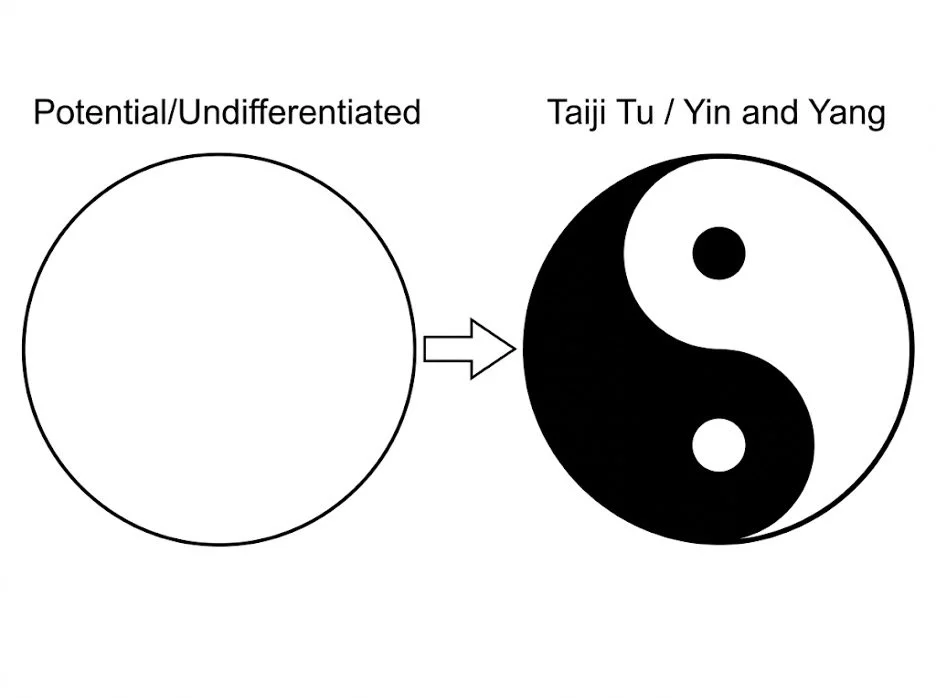
(Pure Potential /Empty Circle/Standstill) ===> (Dynamic Play of Yin & Yang/Movement)
Here is how to practice it:
Emptying (Wuji): Stand completely still with your arms at your sides, quiet and receptive. Don’t intentionally “do” anything. Just notice your breath. Use each exhalation to metaphorically empty yourself of lingering thoughts, tension, and agenda. It helps to hug your ribs towards your spine and make a soft sound of blowing out candles as you exhale.
Sinking (Yin): Gradually allow your knees to soften and bend slightly. Feel your weight sink heavily into the earth so that you feel your feet, your toes, arches and soles. This is your grounded base.
3.Rising (Yang): Keep your upper body light and spacious so that you get a sense of room in your throat and chest and between your arms and torso. Without straining, allow your arms to float effortlessly forward and up to shoulder height, palms facing down.
The Embodied Lesson
Notice how you didn't force your arms up using raw shoulder muscle. Instead, the macro-movement of your arms emerged as a spontaneous byproduct of grounding your lower body and letting your breath expand your torso. Dozens of micro-adjustments in your blood flow, nerves, and muscles combined to create a single, fluid motion. It is a system-wide shift born entirely out of the relationship between the earth beneath you and the space above you.
Applying Emergent Thinking to Daily Life
Once you understand how emergence works in the body, you can start applying it everywhere.
1. In Social Situations
Imagine you send a text to a friend or colleague, and hours or days go by without a reply.
The Old Pattern: Your brain leaps to a rigid and harsh conclusions (“They’re mad at me,” “They don't care,” “I blew it”).
Applying Emergent Thinking: You pause and ask, “What else might be going on here?” You recognize that a response depends on dozens of unseen variables in their day that have nothing to do with what you wrote or what time it is. There could be issues with the network. Your friend could be in the middle of something personal and unrelated. What could be emerging here? Instead of spiraling, you stay curious. You decide to gather more information, maybe following up with a quick phone call or checking in gently later.
2. In Navigating Pain & Flare-Ups
Perhaps the most powerful place to apply emergence is in managing chronic pain or unpredictable flare-ups. When a flare-up hits, it's easy to view pain as a monolithic, unbreakable enemy that you have to battle and conquer. But emergence reframes pain as a dynamic system built from interacting micro-components.
A severe pain episode is usually the macro-result of several smaller “micro” inputs piling up at once:
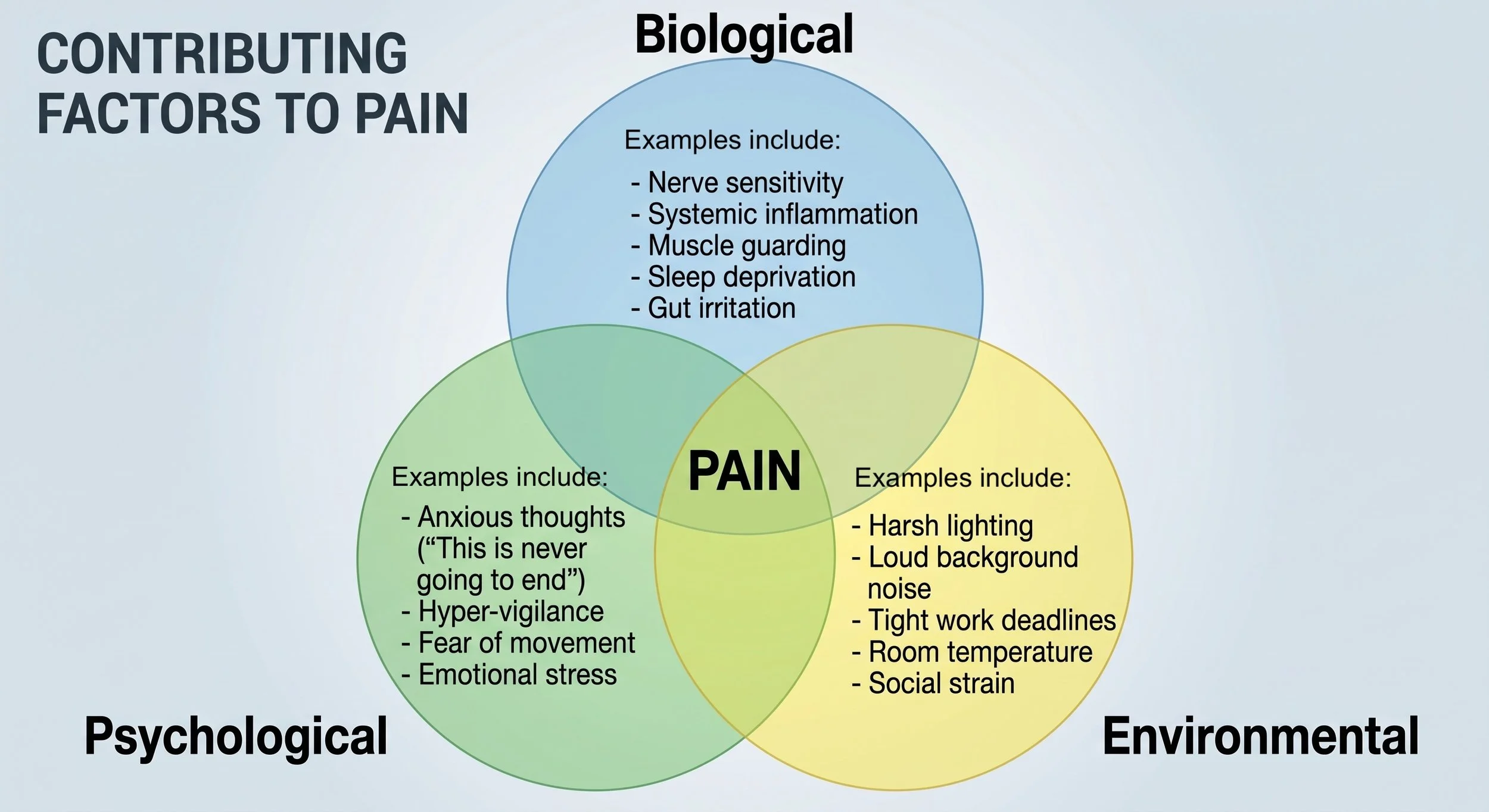
The Venn diagram shows that many factors can stack up and amplify pain and suffering.
When these factors stack up, they amplify one another until your nervous system “tips” into a pain flare.
The Good News: You do not need to fix the entire system to change how you feel! Because the pain state is emergent, changing even one or two interacting variables can shift the whole pattern, preventing a flare all together or helping reduce a pain flare in the moment.
Four Practical Strategies for Everyday Pain Management
Here is how you can use systems-level thinking to intervene when pain or stress arises:
First Strategy: Recognize that the pain experience can loop in cycles:
Notice the small, repeating chains in your daily routine. For example: Poor sleep, increased muscle tension, anxiety about pain, heightened nervous system sensitivity. These factors can happen on one day and make pain worse and then repeat the next day. You don’t have to fix your whole life today; just break one link in this chain. In the moment, right in the middle of suffering, you can take a 10-minute rest or do three minutes of gentle breathing to ease muscle tension. Real-World Example: One student used to eat heavy dinners right before bed, causing digestive distress and poor sleep that fueled his pain during the day. By simply shifting his dinner hour earlier, his sleep quality improved, which dramatically lowered his overall pain levels.
Second Strategy: Get to know where the “tipping point” is:
Think of a flare-up as the moment total stress exceeds your biological capacity. On high-stress days, your system’s bandwidth shrinks. That’s the moment that you can “tip” into a pain flare-up. Just before that happens, you may notice sensations like traffic noise or harsh lighting are feeling extra grating. Not only is this stressful, but these sensations can be frustrating or scary and so make any pain feel worse. When you feel this happening, respect your biology. Lower your demands (especially on yourself). Reduce the noise where you can. Ask for more time on a deadline, step into a quiet room, or give yourself permission to listen to or read instructions a second time.
Third Strategy: Shift something small in the moment:
Remember that you don’t have to fix your entire life in the moment. When pain feels unbearable, remind yourself: This state is dynamic, not permanent. It can and will change. Take charge and create a sense of agency with tiny, deliberate adjustments. Shift your posture. Change clothes. Dim the lights. Get some fresh air. Anchor your attention onto a neutral physical sensation, like cool air flowing across your skin or the sound of birdsong nearby. Say a gentle “no” to taking on one extra task. These tiny actions send an immediate signal of safety to your nervous system.
Fourth Strategy: Watch for Long-Term Patterns (Without Blame):
Keep a light, brief journal of your sleep, stress, activity, and pain. Look for broader patterns over time: notice how work deadlines or holiday travel interact with your physical symptoms. One student noticed that experiencing turbulence on a plane stressed out her nervous system, and then her pain started to flare up in the following days. In the moment of the turbulence, there was no pain, but it was clear upon reflection that after the plane trip she needed a few extra days to recover from the travel. Experiencing pain is not a personal failure. Tracking it simply helps you see what factors are at play so you can adjust expectations and take care of yourself. Another real-world example: Another student began painting on weekends, which unexpectedly led to her taking longer, more restorative lunch breaks during the workweek. Bringing art into her life started changing her perspective on time and work and so gave her more patience with herself, making her weekday pain far more manageable.
Resting in Awareness
Your brain is constantly evaluating whether you are safe or in danger. When it perceives threat, it amplifies pain signals. Emergent thinking gives us permission to slow down and stay curious. Mind-body practices like Tai Chi, Yoga, or slow exhalation breathing aren't just distraction techniques—they are direct messages of safety sent to your brain. By practicing slow, deep breaths in the middle of complexity, you teach your nervous system to separate sensation from threat. You aren’t just coping with adversity better; you are fundamentally changing your relationship to it. Through gentle repetition, your body learns that safety is available from within—in the form of supportive thoughts and quieted muscles. And when you bring that safety into your ordinary, everyday choices, suffering softens, and healing begins.