
The Ritual of the Breath: Why Tai Chi is My New “Smoke Break”
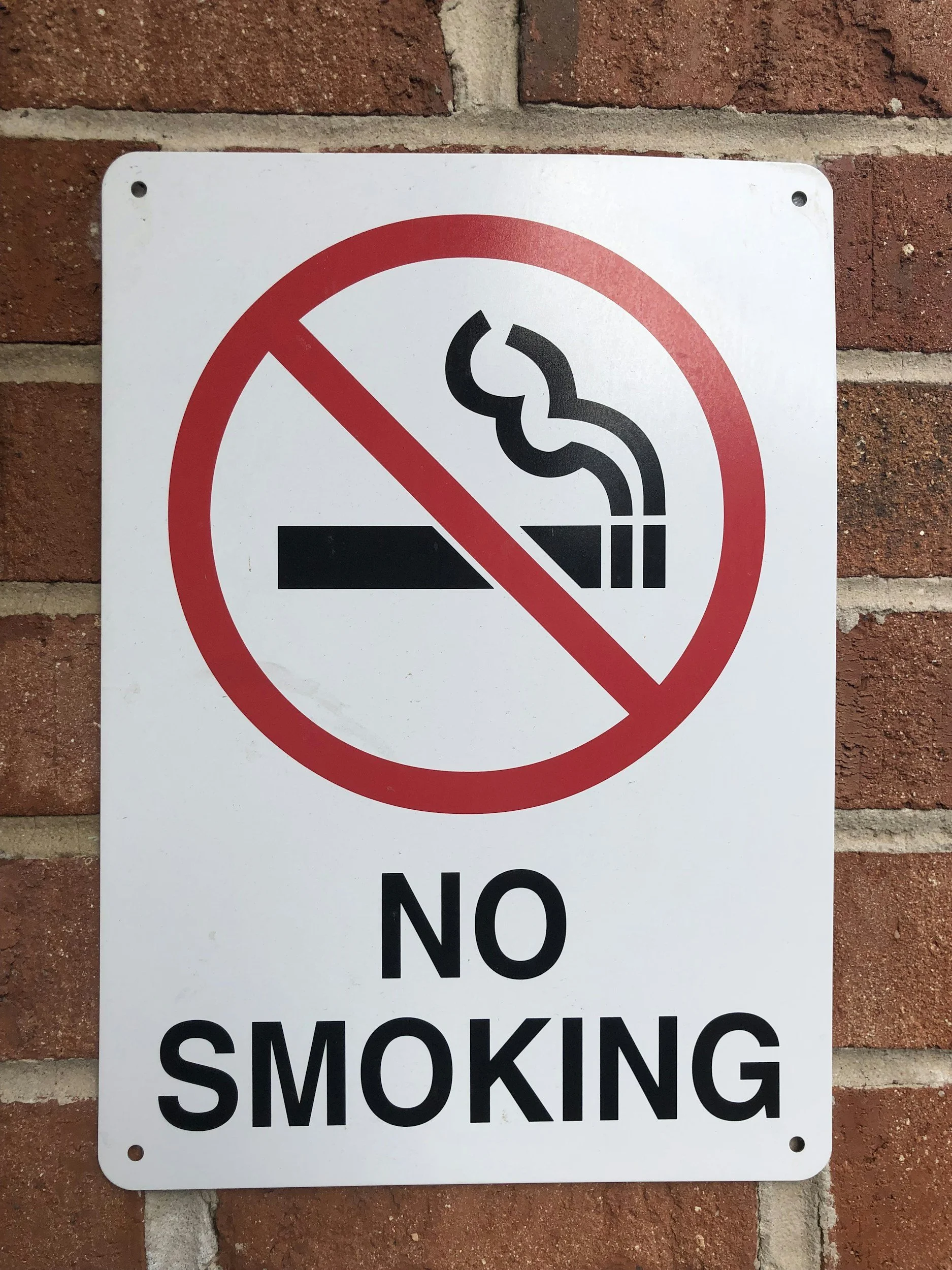
The lowly smoke break occurs in fewer places now
Public spaces are smoke-free by law in many jurisdictions to protect people from second-hand smoke, yet people still smoke. Photo of the the red circular “no smoking” sign by the community of writers known as Blogging Guide at Unsplash.
In a way, smoking is a kind of ritual of the breath. You do it with your breath and can become very aware of your breath when you smoke. It is also not a healthy habit. But there was a time when smoking was everywhere: movies, advertising, and even institutions. A haze of blue smoke in public spaces meant that smokers were present. People smoked and had conversations: smoking was a way of socializing. It’s hard to imagine now, but not long ago, smoking was woven into the very fabric of our lives and socially accepted. I remember seeing ash trays in the stacks of the Oxy library where I spent many nights as an undergrad; back then, it wasn’t just a library—it was a smoking library. That is, until the library fire changed things: It turns out stacks and stacks of books and lit cigarettes don’t go together. After the fire, smokers gathered at a single lounge at the library where there were big windows for ventilation and vending machines where you could get coffee and candy bars to fuel a furious night of study. By the time I was an undergrad, smoking in the stacks was outlawed, but the ash trays were still everywhere, even in the bathrooms. Public places like restaurants had designated non-smoking sections but sometimes the smoke could still reach you at dinner if you sat in these “non-smoking” areas. People lit up on airplanes, trains, and buses. In Europe and Asia, it felt like the smoke followed you everywhere.
Personally, I was a social smoker when I smoked. It was a definitely a ritual of the breath and the mind.
There was a sensory richness to smoking that’s hard to deny. The ritual of the "peace pipe" calmed the nerves and signaled it was break time and time for conversation and sometimes deep thinking. Humphrey Bogart’s private detective character smoked in practically every scene when he played Philip Marlow in The Big Sleep: somehow, solving crimes called for a clarity of mind and steady nerves that seemed to come from the smoking. Historically, philosophy and smoking seemed to go together. Existential philosopher Jean-Paul Sartre smoked two packs of cigarettes a day as well as several pipes full of tobacco. I imagine Sartre hard at work writing Being and Nothingness, deep in thought while puffing away. Deep! Another of my favorite writers, Kurt Vonnegut, smoked every day and said that unfiltered Pall Mall cigarettes were a fancy way to commit suicide. Kurt Vonnegut went on to live until the age of 82, and he died from complications after a fall, not complications from the smoking. What could go wrong with smoking, I thought. Innocently wanting to be like Bogart, Vonnegut and Sartre, I felt drawn to the mysterious habit, thinking I could always quit anytime.
“Have a cigar”
Members of the Beatles all smoked. Smoking and creative work go together somehow. There can be an appreciation of mood and nuance when you smoke. Smoking comes with a complex palette of taste and mood: notes of vanilla, leather, and bourbon; the scent of trees, wood, and steam; that unmistakable bittersweet tang of coffee and ash. I have memories of long, relaxed conversations after meals with my friends where the after-dinner brandy and cigars were meant as dessert. Cigars can take a few hours to smoke, and the chance to really talk or dive into nuance in conversation comes with a sense of losing track of time. It can be relaxing and stimulating at the same time.
The next morning, our clothes smelled terrible.
Even in the high-pressure world of Silicon Valley, the smokers had a secret advantage: they didn’t get carpal tunnel. Why? Because they actually took breaks. They stepped away from the screen, went outside to move, breathe, and reset. By the time I worked in the Silicon Valley as a technical writer, I smoked only cigars occasionally, and my smoker friends several times gifted me high-quality cigars from Costa Rica and Cuba—gorgeous, delicious things that took three hours to finish. You couldn't rush it. You had to be completely present to enjoy the sensory experience of a finely made cigar: hold the cigar in your hands to appreciate its shape and leaf patterns, take in the aromas with your nose as you carefully cut the “cap” so the leaves don’t unravel, light the foot, toast it slightly, puff slowly and patiently to hold the smoke and taste it without inhaling. Take your time. Sit in a comfortable chair. Acknowledge the company you are with—friends who are easy to talk to—and be ready for them or you to launch into telling a story at any moment. Let the ash fall on its own like its marking the time. Then, when enough is enough, let it die naturally on its own rather than smash out the fire. Every part of the ritual is intentional, and so rushing is forbidden.
The Hidden Benefits of the Habit
We focus so much on the "poison" that we often forget why people started smoking in the first place. It wasn’t just about the nicotine; it was about the ritual and the regulation. In public high school, where smoking areas were as common as lockers, I noticed something interesting when I went there to take science and math classes. The “smoking kids” rarely fought. While the non-smokers were busy clashing in the halls or raising their voices, the smokers were outside, self-soothing and self-regulating and talking about music or heartbreak. Some of them played drums or guitar in garage bands. They had a built-in system for peaceful socializing and checking in with each other.
The Catch (And It’s a Big One)
Of course, now it is common knowledge that smoking is bad for you.
Public health policy about smoking changed when the hazards of smoking came to light in 1964: Luther Leonidas Terry was appointed the ninth Surgeon General of the United States from 1961 to 1965. During his tenure, he published the official report on smoking and health, which was a set of warnings against the dangers and the impact of tobacco use on health. Publication of his report influenced the markets and changed how Americans think about tobacco use. Warning labels about the hazards of smoking were mandatory by law for tobacco companies. Smoke-free environments became a social right, not a privilege.
The reality is that smoking is addictive and very hard to quit. Nicotine addiction can happen quickly, because it stimulates the release of dopamine, the neurotransmitter associated with reward and the experience of pleasure and satisfaction. Smoking can make you experience a pleasure you want to repeat. In fact, people who smoke say they crave it. The cravings for the experience of smoking make you seek it out, and then the smoking habit forms. Unfortunately, the habit has consequences that show up in little ways and big ways. I was a social smoker for the most part, but I my chain-smoker friends spent serious cash on their daily habit, and some even bought their supply in bulk. One smoker kept her cartons in the freezer and basically went to great lengths to ensure that she would never be without her supply. The smoking habit affects your choices. The harsh and bigger consequences include lung damage that makes it hard for the lungs to clear infections. Repeated mouth irritation that comes from smoking can increase the chance of tooth loss and gum disease. The heart and immune system are significantly affected: smokers experience a reduced life expectancy by ten years compared to non-smokers according to Healthline. The link between smoking and cancer is common knowledge, and the link to type 2 diabetes and osteoporosis may be less commonly known. As much as we crave the ritual, smoking is devastating for the body. The habit takes a toll.
Any "benefits" of smoking are thus delivered at the great cost of basically taking in poison. So, it is best not to start.
For a long time, I wondered: How do you get the peace, the break, and the social connection without the damage?
The Alternative: Tai Chi
My answer is Tai Chi.
Tai Chi offers everything the smoking ritual once did, but it builds the body up instead of tearing it down.
Think about it:
The Break: Just like those Silicon Valley colleagues stepping outside to reset with a smoke, Tai Chi can move you to step away from the digital grind and reconnect with your physical self. Often practice is done outdoors in the fresh air.
The Ritual: It is a practice of deliberate, slow movements. Like a three-hour Cuban cigar, you cannot rush Tai Chi. It demands that your breath and movements be "completely enjoyed" in the moment. Just breathe and be.
Self-Regulation: It is the ultimate tool for self-soothing. By focusing on the breath and the flow of energy, you achieve that same calm the "smoking kids" were looking for—without the health risks, stinky clothes and smoker’s breath and cough.
Socializing: Best of all, it’s a communal experience. Doing Tai Chi in a group results in an easy, relaxed form of socializing. Outdoors, sharing a peaceful, healthy rhythm with others, you can breathe slowly and deeply and appreciate a simple ritual that quietly celebrates being alive as a human.
If you’re looking for a way to self-regulate and find your "peace pipe" in the modern world, let your ritual of the breath be Tai Chi.
Your lungs—and your mind—will thank you.