Discovering Qi
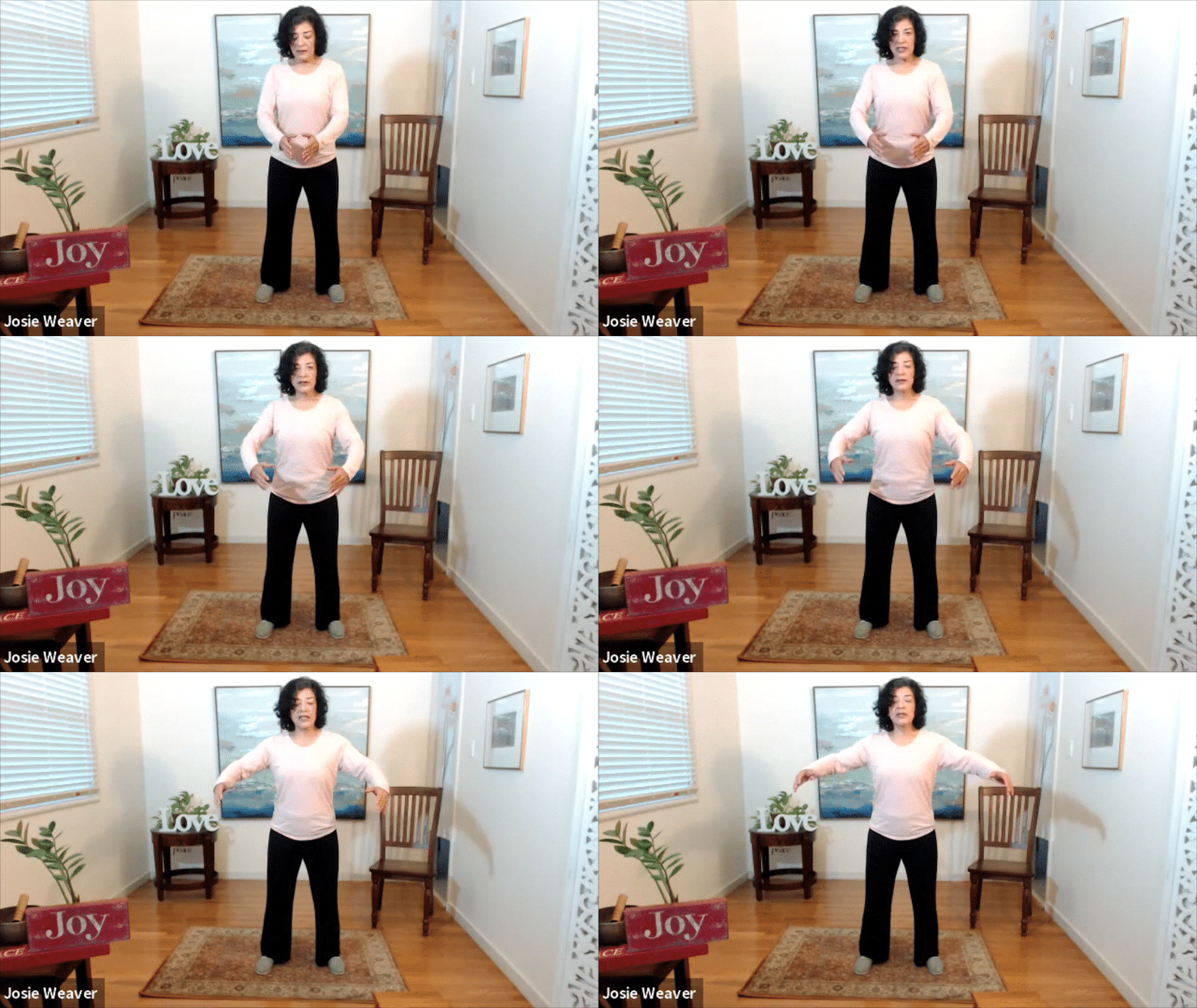
The Discovering Qi movement is sensing Qi in your hands and in space
The GIF shows the basic move found at the start of many mindbody practices to begin sensing Qi and quieting the mind.
“Discovering Qi” is a movement featured in many Qigong forms, and it goes by many names. The movement represents a decision to use the whole body, especially the hands, to sense self and environment in the moment. Classically, to “do” the “Discovering Qi” Qigong form as a physical exercise, you put your hands together first with the palms touching and then slowly separate them to sense the space between the palms. A teacher from way back, playfully described the movement as “playing the invisible accordion.” I encourage students to hold the palms a few inches apart (two inches or ten centimeters), and then listen and observe the sensations that arise in the body, in the hands, and in the mind. You can separate your hands and make the space between them a little bit wider as you take deeper inhalations, thereby illustrating the increase each inhalation with your hands. Similarly, you then bring them in closer but not touching as you exhale and do this very slowly as your exhalations lengthen and deepen. The result is an exquisite matching of your intention, your attention, and your biology. Once you have the pattern, you can change it slightly to “reassign” the movements with the breathing: this means, you breathe in when the palms are close, and breathe out as you separate your hands, as if you are sending your breath into the room or the space you are in.
“Discovering Qi” is a rather simple exercise, and it is everything: this exercise can be observed and experienced on many levels, because Qi is many things. The “Discoveirng Qi” gesture expresses a fundamental principle of all Qigong practices: “Qi” exists and can be sensed on many levels as the dynamically changing components of existence. When we engage in Qigong practices, martial arts, acupressure, and acupuncture, the goal is to sense Qi, move Qi, and transform it.
This is an important topic, but it can also distract you. When you practice the art and science of Qigong, you are “working” the “Qi,” (“gong” means work or cultivate in Chinese). This means investigating Qi, which can mean reading philosophy and being aware of what scientists and people who practice talk about.
Qi is many things. As a central part of Chinese thought and culture, the Taoist masters and teachers spoke about Qi and were known for living long robust lives. According to Taoist philosophy, Qi is the one primal substance, Qi, that animates all systems in the body and in the universe. Qi is to be understood with your sense of the poetic or metaphorical. The term “Qi” has many contemporary meanings as cited by Qigong Master Tienko Ting in his book, Natural Chi Movement, that make it challenging to write about the topic: Qi is air, vapor and atmosphere as well as breath, spirit, influence, bearing/manner, smell/odor, bullying anger and provocation. It is not uncommon in contemporary Chinese culture to say that someone who is imposing their will on you is being “Qi” with you. In the short but intriguing book called A Brief History of Qi by Zhang Yu Huan and Ken Rose, the authors reference the Great Dictionary of Chinese Characters that has 23 meanings for the term Qi (which include the eight mentioned above). For practitioners, scientists and engineers, it can be frustrating to write about the term Qi, because of the imprecision. If Qi means so many things, then what does it mean speak about it, teach it and cultivate it? Do you have to understand it in order to have a positive outcome?
To open up to the concept of Qi, you use your whole self to sense, observe, experience, and connect some dots. I have thought of Qi as a poetic concept that invites imagery and metaphor. You connect mind and body, which may or may not be a foreign concept. You also potentially connect with other minds, concepts and phenomena, which means being willing to deconstruct perceptions and beliefs. The invitation is to consciously shift perspective from seeing isolated “parts” and “pieces” to seeing relationships between parts and considering the whole. In the whole, you can observe processes and interdependencies with a constant exchange among parts. The whole can be thought of as a system that can be influenced to be chaotic or orderly.
Everything expresses Qi and is alive, vibrating, radiating, pulsing and connected. In the natural state, Qi flows, and there is balance and harmony in the system, “by design.” In the natural state, Qi flows in abundance, and things are in balance. I find that it is helpful to think of Qi expression in existence as related to other concepts and phenomena:
Substance – This concept is metaphysical. Living things are made of a single substance appearing as objects and entities. In its natural state, the substance is unifed and orderly and supports all of life and existence. Physically, the substance can have qualities, characteristics, and states. Qi as a “substance” can be gathered and cultivated and “summoned.” Thinking that Qi can be gathered is not necessarily literal, but gathering Qi is a useful way to think of what it is you do whenever you cultivate skills that nurture life and thus nurture the flow of Qi. So, for example, you “gather Qi,” when you rest, exercise, train the body to be strong, and think clearly. There are of course, endless ways to cultivate Qi and gather Qi. The important caveat here is that to this day, Qi is not a substance that can be measured in units, like grams or inches. Some scientific researchers caution against using the term in scientific research, because Qi cannot be measured in any type of units right now.
Energy—Qi can be sensed like vibration and frequency. Qi has force which can be directed to make things happen. Signs of Qi are observable: for example, in humans having energy to move is equated with being healthy and thus having abundant Qi. Another example, is the sun’s light: sunlight literally gives human beings energy directly and indirectly in the form of making plants grow that become food. Sunlight also directly stimulates the mitochondria of individual cells. The pure energy of the sun corresponds to pure Qi.
Information—Qi is information that is ordered and exchanged in living things. A great example is cells “communicating” with one another in nature and in the body. Blood cells circulate in a healthy body and deliver oxygen and nutrients to other cells. The intelligence of the cell appears to be exquisitely coordinated throughout the body, and each cell has a job it can do throughout the day. This is what nature just does, and the examples are endless. Seeds know how to grow into trees when the conditions (water, soil, sunlight) are just right. A “community of cells” such as the cells of an organ like the heart is the result of the long process of evolution. A human heart is a multidimensional structure that is electrical, chemical and energetic. A heart does not beat and exist in isolation. It is connected to life. Thus, a heart responds to life situations that can come from the inside or the outside. The heart beats faster when it is excited and in love, but the same heart beating fast under different circumstances can be anxious and afraid. The information exchange amongst cells creating the shades of experience and meaning is the Qi.
Transduction—Qi transforms from one thing to another in all living structures as they express their existence. The experience of sound is a great example. Sound waves in the environment travel to the ear and vibrate tiny bones and move tiny mechanoreceptors which create bioelectrical signals in the neurons to the brain. The compressed air then gets translated to the sound of music or a human voice by the brain. Mysteriously, the nature of the signals turn into the “substance” of thought and feeling when we give the sound attention and meaning. One thing turns into another thing constantly within the body and within the universe. It is a kind of miracle. These are the natural movements, states, and phases of Qi.
Consciousness—Consciousness affects Qi and is affected by Qi. The mind and will direct Qi. This can be unconscious or conscious. When consciousness expands, Qi can be sensed, directed, and known. Sensitivity and skill in observing and recognizing the flow of Qi can grow over time. With practice, you can direct Qi to heal the body by taking actions and having attitudes that support the flow of Qi. You can recognize patterns and navigate phases of Qi transformation. You can have insight and revelations. Your dreams, imagination, and intuition can become useful to you.
Qi Cultivation and Being
Being aware of the various conceptual aspects of Qi, you can cultivate Qi through simple exercises in Qigong class or any mindbody practice. The practice of listening and becoming available to Qi can also be part of an ordinary day. This means setting an intention to observe the nature of things. You may “Discover Qi” everywhere you go, poised to listen and observe the quality, states, and movement of things and processes. At every level you can discover Qi, in mind, body, and spirit. You can also discover ways to cultivate Qi. Cultivating Qi is simple if you let it be simple. You can pause, breathe, observe. The promise is that you may soon discover that Qi is endless in its expressions and constantly changing and evolving. It is infinite and mysterious. Then the experience of Qi becomes impersonal, but very intimate. As you continue observing and experiencing Qi, you may tap into natural order that is part of the complexity of life, and you may “become the bride of amazement,” as Taoist poet, Mary Oliver wrote.
The natural cultivation of Qi points to a fundamental construct in Chinese thought and philosophy reflected in the Tao Te Ching Chapter 25 by Lao Tzu. A favorite translation of this passage is by Ursula K. Le Guin and shown below. In chapter 25, Lao Tzu describes humans as a phenomenon in the universe, one of the treasures in the universe, where the other treasures include heaven and earth. The thought is that being a part of the universe, and a part of nature, humans are a meeting place of the heavenly and the earthly energies. Humans contain and express both energies. Humankind expresses, through vast and small movements of Qi all throughout existence, a unity of heaven and earth. This unity can express as balance and harmony when humanity is in its pure and natural state of being. May Qi flow naturally and abundantly.
So be it.
--
Tao Te Ching Chapter 25:
Imagining Mystery
There is something
that contains everything.
Before heaven and earth
it is.
Oh, it is still, unbodied,
all on its own, unchanging,
all-pervading
ever-moving.
So it can act as the mother
of all things.
Not knowing its real name,
we only call it the Way.
If it must be named,
let its name be Great.
Greatness means going on,
going on means going far,
and going far means turning back.
So they say: “The Way is great,
heaven is great,
earth is great,
and humankind is great;
four greatnesses in the world,
and humanity is one of them.”
People follow earth,
earth follows heaven,
heaven follows the Way,
the Way follows what is.
Further Reading:
A Brief History of Qi by Zhang Yu Huan & Ken Rose
Chi Gung by L.V. Carnie
Healing Promise of Qi by R.J, O.M.D.
Ji Xia Academy - https://en.wikipedia.org/wiki/Jixia_Academy
Natural Chi Movement by Master Tienko Ting
Tao Te Ching: A Book about the Way and the Power of the Way, by Lao Tzu translated by Ursula K. Le Guin
The Way of Qigong by Ken Cohen
The Web that Has No Weaver by Ted J. Kaptchuk, O.M.D.