Leg Strength, Tai Chi, and Longevity: Get to the Root
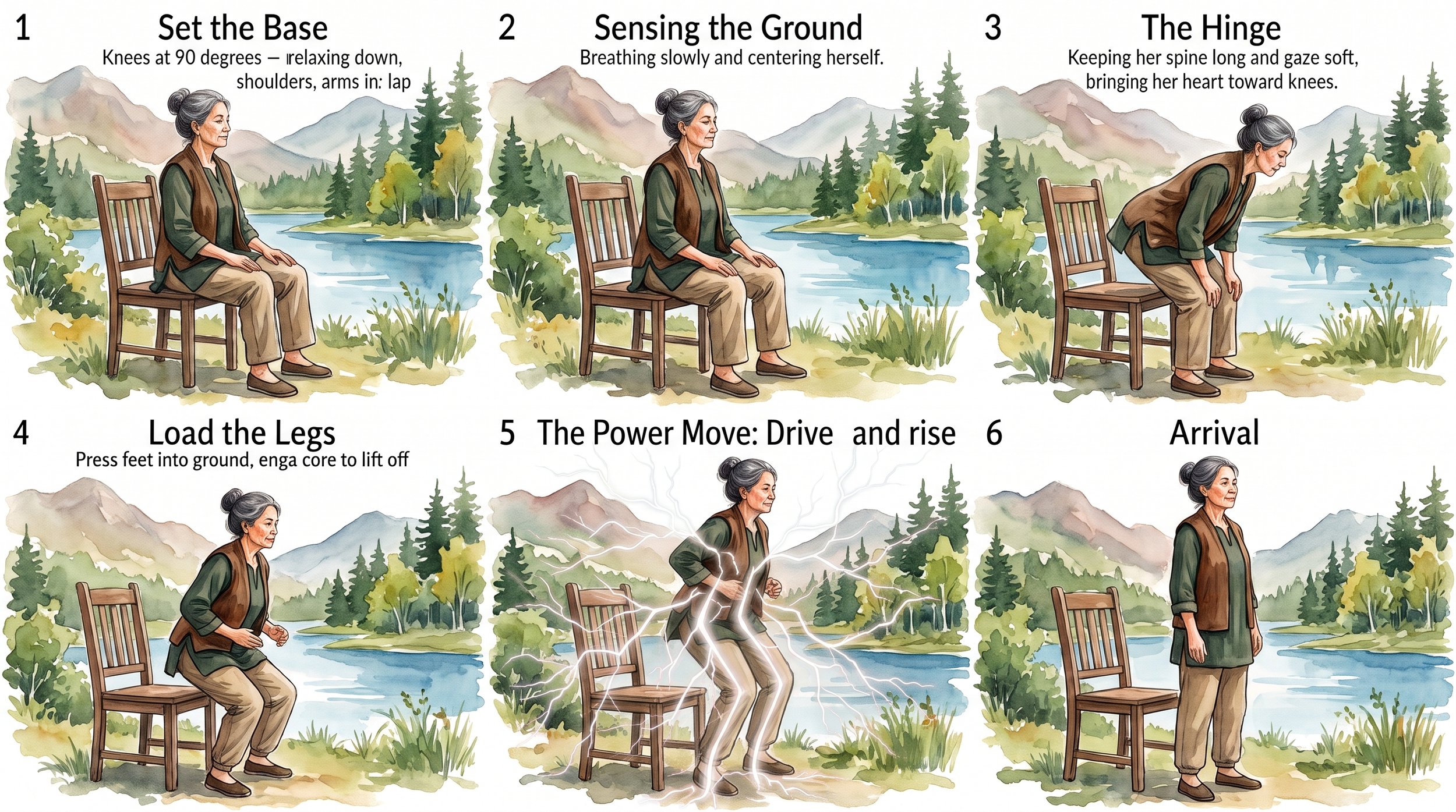
Image created with A.I. illustrates the stand-to-sit practice that strengths the legs. Detailed steps are below.
We often measure fitness by cardiovascular endurance or upper-body strength, but public health research points to a different, often overlooked indicator of healthspan and longevity: lower-body strength. How well your legs support you as you age plays a critical role in determining not just how long you live, but how well you live.
This topic aligns deeply with the concept of eustress—beneficial stress that builds resilience—and sensing strength within yourself and in any situation. Squatting with power and conviction, sensing your legs in standing, walking, and sitting, jumping, shaking, tapping the heels, and breathing through the "bubbling well" (Kidney 1 point on the sole of the foot) are movements that make up an ongoing, dynamic conversation with the earth beneath you.
The Science of Leg Strength and Survival
When I first started taking Tai Chi classes from Master Wong Way-i, I already had strong legs from a robust yoga practice combined with regular cycling miles. My Tai Chi nickname was “Strong Legs” before I became a regular student of his. At the time, little did I know that Tai Chi makes and keeps your legs strong. Leg strength is directly linked to health, vital energy, and longevity, and there is robust science that backs it up. It makes sense that having strong legs is the result of actively participating in the world. Getting out into the world to walk, squat, dance, and move about means you are engaging with your environment and very likely also socializing with others. This kind of participation also means the world is working on you by challenging you to you to adapt, learn new things, and be alert. This is how you stay strong.
What the Research Shows
Quadriceps Torque Predicts Survival: In landmark epidemiological research from the Health, Aging and Body Composition Study, Newman et al. (2006) followed thousands of older adults and discovered that lower-body isometric strength (specifically quadriceps strength)—rather than total muscle mass—serves as a primary predictor of all-cause mortality.
Single-Leg Balance as a Biomarker: A study published in the British Journal of Sports Medicine found that the inability to complete a 10-second single-leg stance was associated with an 84% higher risk of all-cause mortality over a 7-year follow-up (Araujo et al., 2022).
The Sitting-Rising Test: Clinical trials evaluating functional movement revealed that the ability to transition from sitting on the floor to standing with minimal reliance on hands or knees strongly correlates with long-term survival (Brito et al., 2012).
Astronauts in Space Lose Muscle in Zero Gravity
The force of gravity is important to our well-being, and physical movement like Tai Chi helps you build a relationship to it. When astronauts returned from early space missions, they experienced rapid loss of muscle mass and bone density due to the lack of gravitational resistance. Climbing stairs after landing told an illuminating story of getting used to gravity again: astronauts reported feeling as though they had to push down with immense effort onto each stair step just to propel their bodies up a single flight. It was exhausting, but it was essential reconditioning.
This astronaut example reveals a core principle of Tai Chi movement. Unlike classical ballet or dance, where the aesthetic intent is often to “lift” away from the floor and touch it as lightly as possible, in Tai Chi, the floor (the earth) is your primary source of strength. All your power originates from the earth. You eat food that grows on the earth, and the food nourishes you to make you strong. The physical interaction with gravity’s pull is what conditions your frame. In Tai Chi, you learn to feel the subtle downward pull of the earth and press against it so that the earth “pushes” back.
Grounding and Rootedness as “Gravity Surfing”
Some of my Tai Chi friends refer to Tai Chi practice as a form of “gravity surfing.” You get to know gravity intimately, developing a heightened sensitivity to energy between your own body and the earth. In this state, you learn to sense other physical bodies and objects in space. In martial arts and somatic practices, grounding is what makes this clarity of sensing self and others possible. “Grounding” is a term that takes on several meanings in various context. Here is a sample:
Electrical Grounding is a direct physical connection to the earth’s surface that creates safety for the flow of electricity.
Emotional Grounding is a state of nonarousal and calm, characterized by emotional self-command.
Physical Grounding is clear contact with a surface from which you can push off or receive support.
Energetic Grounding is A downward flow of energy toward resolution, balance, centeredness, and restoration to original states of wholeness.
In esoteric teachings, earth energy acts as the great cosmic recycling center, where spent energy gets composted and transformed. Being in contact with the earth is what helps you stay healthy and alive, because it helps you “digest” experience, which can mean taking life experience in and making sense of it. Poetically, Tai Chi is described as a love story and a dance between the expansive sky and the solid earth. When there is a harmony between sky and earth, between action and receptivity, human life flourishes in between. Staying physically rooted as you move can be an embodiment of emotional and energetic grounding. This can mean staying in touch with core internal values and sources of support of those values: For example, being rooted or grounded in core values like virtue, justice and reverence can mean having clarity in communication and honesty in dealings, which (little by little and step by step) lead to positive outcomes for all. You cultivate a foundation to remain grounded and true to your ideals and values amidst life’s activities and interactions, which can sometimes include turbulence and opposition. With such a foundation, being grounded sets the stage for compassion and constructive action.
The other day, I heard the famous sign-off phrase of voice actor and radio personality, Casey Kasem:
“Keep your feet on the ground and keep reaching for the stars.”
Keeping your feet on the ground, as you do in Tai Chi, is a way to build strength in your lower body while you seek the light.
Tai Chi Builds Leg Strength: 4 Key Clinical Studies
While conventional gym workouts build muscle mass using heavy external weights, Tai Chi builds functional, operational leg strength through sustained isometric holding, muscular leg stances (squatting and lunging), and continuous weight transfer. Modern biomechanical and clinical studies confirm that this deliberate, slow movement builds powerful lower-extremity conditioning. In my association with Qigong Institute, I came across noteworthy research that showed this was the case.
For example, research in the Journal of Aging and Physical Activity verified that slow, single-leg weight shifting recruits the gluteus medius and quadricep muscles of the lower body, offering strength gains comparable to resistance exercises (Tsang & Hui-Chan, 2005). Tai Chi has been evaluated as an effective intervention for preventing falls: a systematic review in BMC Geriatrics showed Tai Chi exercises are beneficial for improving balance and increasing strength of lower-limb muscle resulting in increased muscle density, improved gait velocity, and sit-to-stand power (Pan et al., 2018).
A meta-analysis published in Frontiers in Public Health, based on 25 randomized trials involving 1,995 participants, indicates that Tai Chi serves as an effective rehabilitation intervention for the elderly. Among the reported effects of regular Tai Chi practice, the studies showed significant increases in knee extensor (quadriceps) strength and “flexor torque” (the rotational force produced by the muscles that bend the knee) in adults. The good news is that Tai Chi strengthens the legs without high-impact joint wear (Wu et al., 2021).
There are other benefits of Tai Chi, not just strength, that improve your sense of root and groundedness. Tai Chi also enhances proprioception, your body’s sense of its position in space, which gets sharp as you practice and refine movement. Because muscles control the movement of joints and bones, strong muscles means better control. A randomized trial in Archives of Physical Medicine and Rehabilitation found that Tai Chi training significantly improves ankle joint position sense and surrounding stabilizing musculature (Fong & Ng, 2006). Knowing the feel of your limbs gives you a sense of command over them.
The Intelligence of the Squat
In classic Tai Chi forms, deep squatting often serves as a key movement during a closing sequence, namely the posture “Gathering Heaven and Earth.”
Squatting is a great exercise that requires leg strength, and it undervalued in Western societies. Because we spend our days in chairs and on elevated toilets, it can be challenging to practice a good squat, but practicing squats is a great lower-body strengthener. While visiting Asia, I was struck by the prevalence of squat toilets, and felt admiration for the cultural and social support to have children grow up with a squatting habit that they can take with them into old age to stay strong. The squat is an essential human movement and fantastic lower body training.
The Tai Chi squat is executed very slowly, making it both physically challenging and deeply educational. It reveals whether your legs feel strong or weak and teaches you how your body transfers force.
Practical Drill: The Sit-to-Stand Exercise
You can cultivate squatting intelligence right in your living room using a sturdy chair:
Set the Base: Sit on the front edge of a sturdy chair so your weight rests at the base of your spine. Bend your knees at roughly 90 degrees with your feet flat on the floor, directly underneath your knees.
Sensing the Ground: Take a slow breath. Relax your upper body completely—shoulders down, arms passive.
The Hinge: Hinge forward at the hip flexors, keeping your spine long and guiding your heart toward your knees. Keep your gaze angled softly downward with neck and shoulders relaxed.
Load the Legs: Press your feet firmly into the floor. Pause here to feel your quadraceps (front of the thigh muscles), hamstrings (back of the thigh muscles), and glutes (buttocks muscles) turn on. Your hips should feel weightless on the chair but still touching the chair lightly.
The Power Move: Plunge your weight into the earth through your feet and drive yourself upward. Your legs do 100% of the work—no pushing with arms or swinging upper body momentum.
Arrival: Stand tall. Your heart ascends first, followed by your head, and finally your eyes take in the surroundings.
If this feels difficult initially, simply practicing the setup and pressing into the ground while keeping the upper body relaxed will begin recruiting motor units and building real strength.
Conclusion: Trusting Your Base
Building leg strength isn't just about athletic output; it is an investment in your independence, vitality, and peace of mind. When you command your legs to support you, you develop a somatic trust in your own body. Incorporating Tai Chi or slow squatting drills into your daily routine offers a gentle, highly effective way to stay grounded, harvest earth energy, and keep your legs strong for life.
References
Araujo, C. G., de Souza e Silva, C. G., Laukkanen, J. A., et al. (2022). Successful 10-second one-legged stance performance predicts survival in middle-aged and older individuals. British Journal of Sports Medicine, 56(17), 975–980.
Brito, L. B., Ricardo, D. R., Araujo, D. S., et al. (2012). Ability to sit and rise from the floor as a predictor of all-cause mortality. European Journal of Preventive Cardiology, 21(7), 892–898.
Fong, S. M., & Ng, G. Y. (2006). The effects of Tai Chi on bone mineral density and joint proprioception. Archives of Physical Medicine and Rehabilitation, 87(1), 82–87.
Li, F., Harmer, P., Fitzgerald, K., et al. (2012). Tai Chi and postural stability in patients with Parkinson's disease. The New England Journal of Medicine, 366(6), 511–519.
Newman, A. B., Kupelian, V., Visser, M., et al. (2006). Strength, but not muscle mass, is associated with mortality in the Health, Aging and Body Composition Study cohort. The Journals of Gerontology: Series A, 61(1), 72–77.
Pan, Z., Zhang, X., & Yukthamarani, P. (2018). The effects of Tai Chi on lower limb muscle strength in older adults: A systematic review. BMC Geriatrics, 18(1), 174.
Wu, X., Zhuang, J., & Zhang, Y. (2021). Meta-analysis of elderly lower body strength: Different effects of Tai Chi exercise. Frontiers in Public Health, 9, 784101.